Things to Do in Bologna: What Is Worth Your Time (2026)
The best things to do in Bologna on a first visit are Piazza Maggiore, San Petronio, Santo Stefano, the Quadrilatero and the city’s historic porticoes. Add the Clock Tower for a view or San Luca for a longer outing. Bologna Welcome has mapped a 2.5 km central walk that takes about three hours, but museum visits and meals will add time.
This guide helps you choose attractions by interest, rather than follow a fixed route. If you want the stops arranged into two days, use our two-day Bologna itinerary. For the wider collection of city guides, see our Bologna sights and activities guides.
The Short List for a First Visit
Start with six places. They give you Bologna’s civic center, religious architecture, food culture and a choice of two very different views.
- Piazza Maggiore and the Neptune Fountain. The square is the city’s central landmark, framed by San Petronio and the old municipal buildings. Neptune stands just beyond it, in Piazza del Nettuno. Both are free to see.
- Basilica of San Petronio. Enter for the unfinished facade, the vast interior and Cassini’s meridian line. General admission is free; three decorated chapels have a separate ticket.
- The Quadrilatero. Walk the narrow market streets behind Piazza Maggiore, then decide whether to stop for a snack or a meal. Browsing costs nothing.
- Santo Stefano. Visit the interconnected churches, courtyards and cloister of the complex nicknamed the Seven Churches. Entry is free, with a donation welcomed.
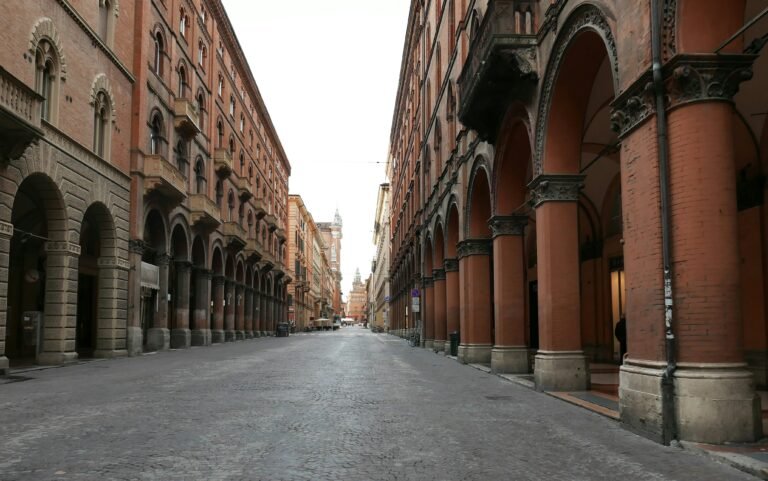
- The historic porticoes. You will walk under covered arcades throughout the center. For a more demanding outing, follow the portico toward San Luca on the hill.
- One panorama. Choose the Clock Tower beside Piazza Maggiore for a central view, or the Sanctuary of San Luca for a hilltop setting. The Clock Tower requires a timed reservation; the sanctuary church is free.
A guided walk can help if this is your first morning in town and you want an explanation of what you are seeing. Our pick below is a city-center walking tour; the other two cards are a small-group walk and a tour that adds a tower view and the Archiginnasio. Check the listing for the meeting point and the language on your date.
The city’s tourist office also runs its own Discover Bologna walking tour. It lasts two hours and costs €18, which makes it a useful direct-booking reference when you compare what a guided visit includes.
Historic Center: What Should You See on Foot?
Piazza Maggiore, Neptune and Palazzo d’Accursio
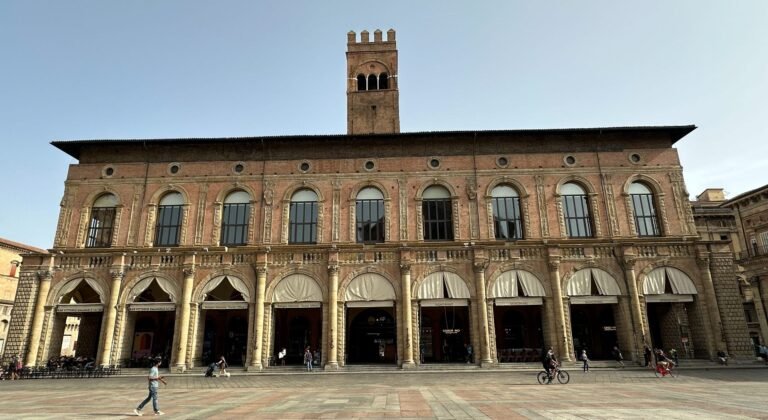
Piazza Maggiore is the natural starting point because several principal sights face the same square. The Basilica of San Petronio occupies one side, while Palazzo d’Accursio, the former seat of municipal government, stands on another. The Fountain of Neptune is in the adjoining square.
Walking through the square is free and does not require a reservation. You can look at the fountain, the exterior of the public buildings and the changing perspective along the porticoes without buying a ticket. This makes the area useful even when museum opening hours do not fit your plans.
Palazzo d’Accursio needs a little more care. Bologna Welcome lists free general access, but the historic council rooms are open only on guided visits, subject to use by the municipality. The Clock Tower and the Municipal Art Collections form a separately ticketed visit. Do not assume that every door in the palace leads to a visitor attraction.
San Petronio and the Archiginnasio
Inside San Petronio, look for the long meridian line created by the astronomer Gian Domenico Cassini. The basilica’s own visitor page states that the church is open daily from 10 a.m. to 6 p.m., with last entry at 5:50 p.m., and that the three-chapel visit costs €5 for an adult. Groups of 15 or more must arrange entry in advance; smaller groups do not need to. Bologna Welcome describes the basilica itself as free of charge.
The nearby Palazzo dell’Archiginnasio tells a different part of Bologna’s story. Its courtyard recalls the university’s historic presence in the building, and entry to the building, including the courtyard, is free. The Anatomical Theatre, once used for teaching anatomy, is on the upper floor and must be booked online in advance.
Bologna Welcome lists two options: a €10 audio-guided visit of the theatre and the Stabat Mater Hall, or a €12 guided visit that can add further rooms when they are not in institutional use. The building opens Monday to Saturday from 9 a.m. to 7 p.m. and closes on Sunday. Check the booking page for the visiting times of the theatre itself. The library is for study and is not a tourist attraction.
The Quadrilatero and the Two Towers
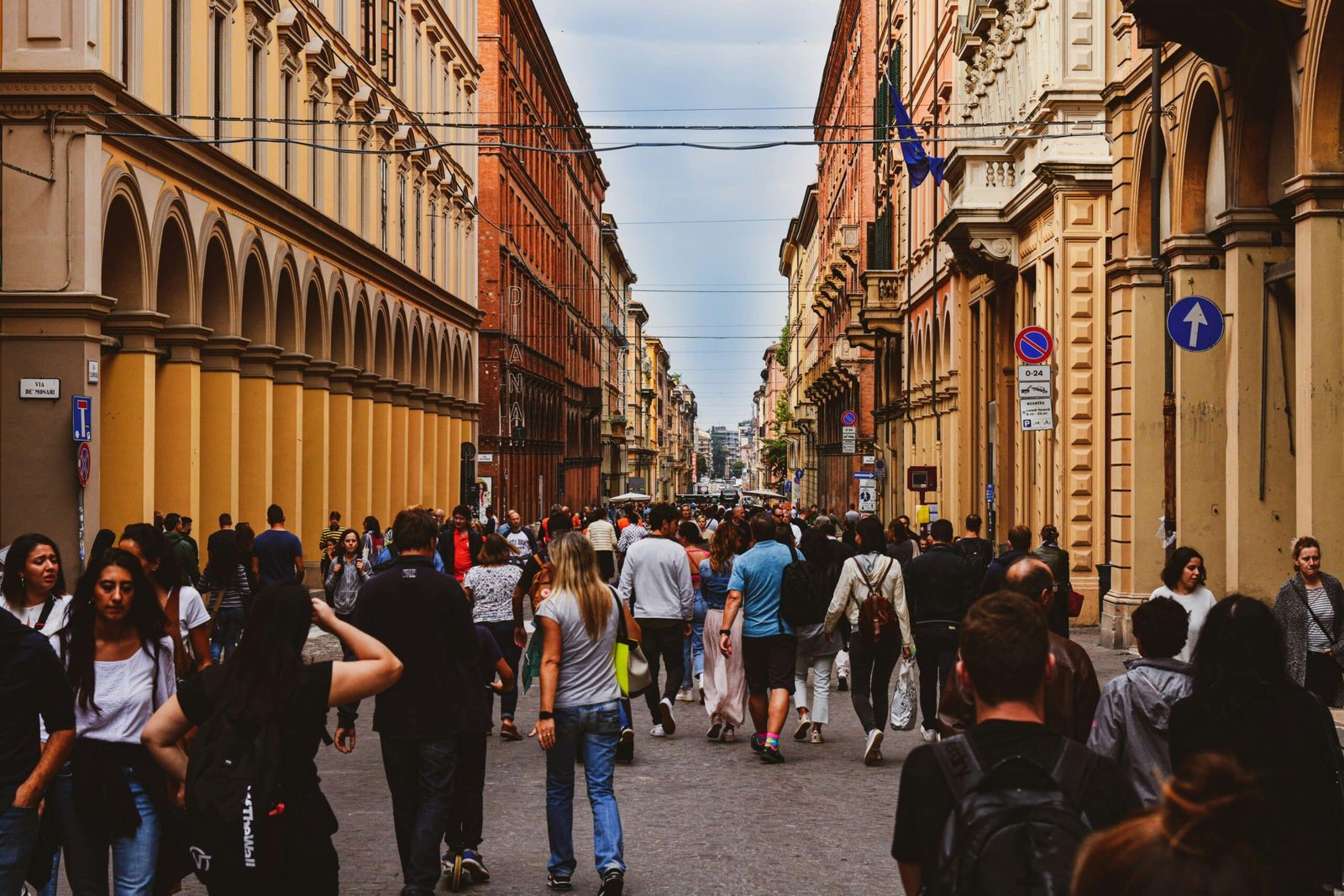
The Quadrilatero is a network of market streets rather than one attraction with a gate. Specialist food shops, market counters and places to eat occupy the narrow streets behind Piazza Maggiore. You can inspect the displays without buying a tour or an admission ticket. Shops set their own opening times, so do not treat the district as a single market with fixed hours.
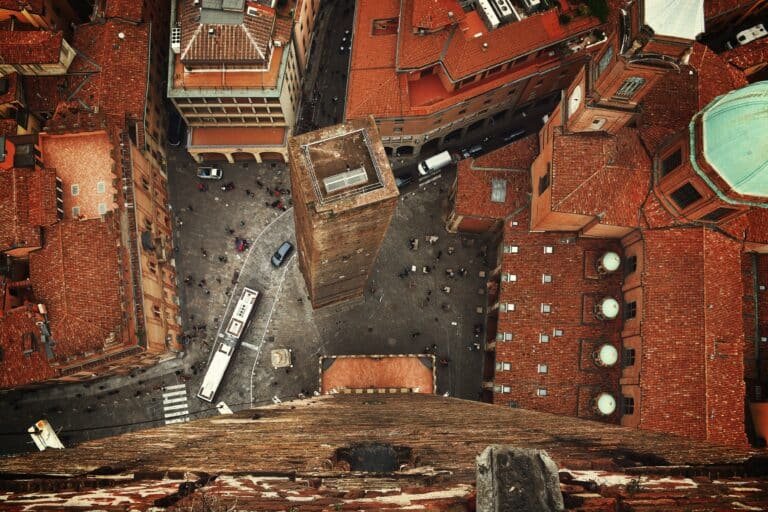
From here, the Two Towers are an obvious landmark to look for, but they come with a warning. Neither tower can be climbed. Bologna Welcome states that the Asinelli Tower is closed for area maintenance and that the Garisenda Tower is not accessible while it is being restored. Treat the towers as an exterior landmark, not a ticketed activity.
For more on the closure and the best alternatives, see our guide to the Asinelli Tower closure.
Views: Which Climb Is Open?
The Clock Tower
The Clock Tower at Palazzo d’Accursio is the central viewpoint to choose while the Asinelli Tower is closed. Bologna Welcome’s booking page lists an adult ticket at €10 that includes the tower visit, with an audio guide, and the Municipal Art Collections. The tower visit takes about 40 minutes, with timed admission at 00, 20 and 40 minutes past each hour, and reservation is compulsory.
From September 7 through December 31, 2026, the first tower admission is at 10 a.m. and the last is at 6:20 p.m., with an earlier last admission on December 24 and 31. The tower closes on December 25, and the collections keep different hours and close on Mondays. The building has no elevator, so consider the stairs before you reserve.
San Luca and Its Portico
San Luca is the choice for a longer outing. The sanctuary stands above the city, reached by a portico of more than 600 arches that starts at Porta Saragozza. Bologna Welcome describes the covered approach as about four kilometers long. That figure is for the portico, not a timed walk from your hotel.
The sanctuary church is free and open daily from 7 a.m. to 6 p.m., closing 30 minutes later from March to October. Visits may be limited during religious services. The panoramic terrace is a separate experience with its own admission arrangements, so do not confuse a free church visit with free access to every viewpoint.
You have two main ways up: walk under the portico, or take the San Luca Express sightseeing train. The train is operated by City Red Bus, and its ticket page lists €15 for a full-price ticket with an audio guide, daily service until January 6, 2027 and a departure from Piazza Galvani. You get off at the sanctuary and take a later vehicle back the same day. Our guide to Bologna’s porticoes covers the walk in more detail.
The ticket above is the operator’s own. The offer below is a separate GetYourGuide ticket that adds a food tasting, which is why it costs more.
The Specola Museum
There is another climb if you are interested in astronomy as well as rooftops. The University of Bologna’s Specola Museum has a historic tower with 272 steps that ends at a panoramic terrace.
Admission is €8 for an adult. Visits enter on the hour, last at most 60 minutes and are limited to 15 people at a time. Booking is strongly recommended. The museum opens Tuesday to Friday from 10 a.m. to 4 p.m. and on weekends and holidays from 10 a.m. to 6 p.m. The terrace closes in rain or snow, and the university does not permit access to the tower for visitors with reduced mobility.
Museums: Which One Matches Your Interests?
Bologna has more museums than most short visits can accommodate. Choose one based on the collection, rather than trying to fit several into a single afternoon. Our full guide to Bologna’s museums covers the wider range, including Motor Valley options that fall outside this city-only guide.
Art and History
Pinacoteca Nazionale is the choice for historical painting. Its visitor page lists an adult ticket at €12 and opening Tuesday to Sunday from 9 a.m. to 7 p.m. It closes on Mondays and is free on the first Sunday of each month, although special dates can change the arrangements. Individual visitors do not need to reserve; groups of 8 to 25 must book.
Museo Civico Medievale is better for objects that explain medieval Bologna: sculpture, arms, manuscripts and the city’s civic past. The adult ticket is €6. It is closed on Mondays and has much shorter hours on Tuesday, Wednesday and Thursday than from Friday to Sunday, so check the day before you add it to your plan.
Science and Contemporary Art
Museo di Palazzo Poggi holds the university’s historical scientific collections, including anatomical models and instruments, and its visit route ends in the monumental rooms of the University Library. The adult ticket is €10. It opens Tuesday to Friday from 10 a.m. to 4 p.m. and on weekends and holidays from 10 a.m. to 6 p.m. Independent groups of more than ten must reserve; individual visitors do not.
MAMbo, the city’s modern art museum, is an alternative if you prefer more recent art. The €6 ticket also covers the Morandi Museum. MAMbo is closed on Mondays and open Tuesday to Sunday, with the latest closing, at 8 p.m., on Thursday.
A museum visit is a poor fallback if you have not checked the weekly closing day. Mondays affect MAMbo, the Medieval Museum, the Pinacoteca and Palazzo Poggi; the Archiginnasio is open on Mondays but closes on Sundays. These differences matter more than a blanket rule about Bologna museums.
Churches Beyond San Petronio
Santo Stefano, the Seven Churches
Santo Stefano is one of the strongest alternatives to a paid museum. Its nickname, Seven Churches, refers to a complex of interconnected religious structures built in different periods, not seven independent churches you need to locate around town. Inside are courtyards, chapels and a cloister that show how the site developed.
Bologna Welcome lists free admission with a donation. The complex is closed to tourists on Mondays, when only the Church of the Crucifix opens for Mass in the evening. On other days it opens in morning and afternoon sessions with a midday break. Religious services can restrict visits, and the published Sunday afternoon times are not consistent, so confirm a Sunday visit with the complex before you rely on it.
Basilica of San Domenico
San Domenico is another free church visit. It houses the shrine of Saint Dominic, with sculpture by artists including Michelangelo and Nicola Pisano, and a wooden choir that is a Renaissance inlay masterpiece. It is a stronger choice for visitors interested in religious art than for those collecting landmark photographs.
The church keeps split morning and afternoon visiting hours, and visits may stop during worship. The separate museum is open by request, so do not assume that entry to the basilica also opens every room.
Food, Markets and Experiences
Food is part of sightseeing here, but this page is not a restaurant ranking. Begin in the Quadrilatero to understand the layout of the old market streets. Mercato di Mezzo, on Via Clavature, is a covered market with food and wine if you want somewhere specific to stop. Neither walking the district nor browsing the market requires a guide.
For dishes and places to eat, use our Bologna food guide. If you want to learn the methods behind local pasta rather than sample dishes across shops, compare Bologna cooking classes. For an evening drink and snack, see our Bologna aperitivo guide.
A guided food walk can be useful if the purpose is tasting several specialties with context, rather than shopping independently. Our pick for that need is the walking food tour below. Check the listing for the inclusions, the meeting point and dietary options.
What Can You Do for Free?
Three choices stand out if you want substantial sights without an admission ticket. They also combine with paid activities without requiring a separate day of travel.
First, visit Piazza Maggiore and the Neptune Fountain. Both are public spaces. You can see the principal facades and monuments from outside without buying a city pass.
Second, enter San Petronio or Santo Stefano. Both have free general admission, although paid chapels or other ticketed spaces are different. Santo Stefano invites donations, and a church service may limit sightseeing access.
Third, walk under the historic porticoes. There is no ticket to stroll the public arcades, including the approach to San Luca. The hill route requires more effort than a walk through the center, so choose it for the experience itself, not merely to save an admission fee.
You can also look through the Finestrella di Via Piella toward the old canal. It is a brief street-side stop, not an attraction with a scheduled tour or a guaranteed uninterrupted view. Our guide to Bologna on a budget covers more no-ticket ideas without repeating them here.
What About Children or Rain?
With children: Salaborsa is a practical central stop. It is a free library with dedicated areas for children and teenagers, and a glass floor in its covered square lets you see ancient excavations below. The San Luca Express is another possibility if the hill walk is too demanding, but its departure and return rules matter when you plan around children. For age-specific options, see our guide to Bologna with kids.
When it rains: choose a ticketed indoor visit by interest. The Archiginnasio’s Anatomical Theatre suits history and science, MAMbo covers modern art and Palazzo Poggi concentrates on the university’s scientific collections. Do not plan the Specola terrace as your rain solution, because it closes in rain or snow. The porticoes offer sheltered stretches between buildings, but they do not make a long outdoor outing weatherproof.
If you want less familiar places once the central sights are covered, use our guide to lesser-known Bologna sights. It gives those places room without turning this selection guide into another long attraction catalog.
What Is Closed or Not Worth Planning Around?
The biggest planning mistake is buying time for a climb that cannot happen. The Asinelli Tower is closed to visitors, and the Garisenda Tower is not accessible. In its roadworks notice of October 23, 2026, the municipality lists Piazza di Porta Ravegnana as closed at the junctions with Via San Vitale and Via Rizzoli for structural monitoring of the Garisenda. You can still see the towers from the permitted public areas.
The former panoramic terrace at San Petronio is, according to the basilica’s visitor page, permanently closed after restoration works. Do not confuse it with the open Clock Tower or Specola viewpoints. Palazzo Pepoli Campogrande, listed on the Pinacoteca’s visitor page, is marked temporarily closed; the main Pinacoteca remains open.
Bologna’s new tram is also not a sightseeing option yet. The municipality reported that technical road tests began in October 2026, mainly in the evening, and are due to extend toward the historic center in the following weeks. The notice describes tests, not passenger service, so do not build a sightseeing day around a tram departure.
Not every famous sight needs a long stop. If a building is shut, an exterior view can be enough. Save the next hour for a museum or neighborhood that you actually want to explore.
How Many Sights Fit Into Your Stay?
Half a day: concentrate on the central landmarks. Bologna Welcome describes a 2.5 km historic-center route of about three hours that connects squares, churches, the market area and the exterior of the Two Towers. Allow separate time for food or ticketed interiors.
One day: choose the central landmarks, then add one indoor visit or the Clock Tower. The question is not how many names fit on a list, but which place deserves the part of the day you have left. See our one-day Bologna plan.
Two days: use one day for the center and keep a longer outing, such as San Luca, for the other. The full sequence is in our two-day Bologna route.
Three or four days: you can add another museum, time in less central neighborhoods or a slower food-focused day. For a longer route rather than a new list of attractions, see our three-day Bologna plan.
Tickets and Booking: What Needs a Reservation?
A ticket is not always the same as a required reservation. The Anatomical Theatre requires online booking. The Clock Tower requires a reservation and uses timed slots. The Specola Museum strongly recommends reservations because its tower admits 15 people at a time. The Pinacoteca sells tickets to individuals without advance booking, while groups of 8 to 25 must reserve. For an ordinary visit to Piazza Maggiore, the Quadrilatero or the main nave of San Petronio, there is no paid admission requirement.
On the tourist office’s official card page, the Bologna Welcome Card Easy costs €35 and the Plus costs €55. Both include eligible museums, the Discover Bologna walking tour, the Clock Tower and a city-bike rental. Plus adds the San Petronio chapels, City Red Bus and the San Luca Express. The card is valid for up to 15 days or until the included services are used up, and the Clock Tower, the walking tour and bike rental must be booked in advance.
Do not buy a card simply because you are spending two days in Bologna. Add up the admissions you will really use. A visitor seeing free churches and public squares may spend less buying an individual Clock Tower ticket, while a museum-focused visitor who joins the included walking tour may get more from a card. Compare your own choices with our Bologna Welcome Card cost comparison.
For guided sightseeing, use the walking tours above as the first choice. If you prefer an independent visit with a view, book the Clock Tower directly on Bologna Welcome’s booking page.
Frequently Asked Questions
What Are the Main Things to See in Bologna?
Start with Piazza Maggiore, San Petronio, the Quadrilatero, Santo Stefano and the porticoes. Together, these cover Bologna’s civic center, religious history, food-market streets and characteristic architecture. Add a tower or museum based on the time available. The Two Towers remain worth recognizing from outside, but neither is open for a climb.
What Can You Do in Bologna in Two Days?
See the historic center on one day and give the second to San Luca, a museum or a longer food experience. You do not have to combine all three. For the actual order of stops and practical transitions, follow our two-day Bologna itinerary.
Are There Free Things to Do in Bologna?
Yes. Piazza Maggiore, the Fountain of Neptune, the public porticoes, and general entry to San Petronio and Santo Stefano do not require an admission ticket. The sanctuary church at San Luca is free as well. Chapels, museums, panoramic terraces and guided experiences may have separate fees.
Can You Climb the Towers in Bologna?
You cannot climb the Asinelli or Garisenda towers. For a view in the center, choose the Clock Tower at Palazzo d’Accursio. The Specola Museum also has a rooftop terrace, but its 272 steps, small visitor capacity and weather restrictions make it a different kind of visit.
Is Bologna Worth Visiting With Children?
Yes, provided you choose activities by age and stamina. Salaborsa offers a free central indoor stop, while squares and short portico walks make flexible outdoor options. The San Luca Express avoids the uphill walk, but check its departure and return arrangements. Our guide to Bologna with kids has a more complete selection.
Do You Need to Book Bologna Attractions in Advance?
Reserve the Anatomical Theatre and the Clock Tower, and consider booking the Specola tower because of its limited capacity. Individual museum tickets are often simpler, though special exhibitions and group rules can differ. Free public squares and market streets need no reservation. Always confirm the date on the venue’s official page before you pay.