Bologna Transport Guide 2026: Airport to City, Trains & Buses
The fastest way from Bologna Airport (BLQ) to the city center is the Marconi Express: about 7 minutes to Bologna Centrale for €12.80 one-way, with up to eight departures an hour at peak times. A taxi takes about 20 minutes and costs around €20 to €25 on the meter. TPER Line Q is the budget option at €2.30.
What matters more than the vehicle is where you end up. Bologna Centrale is 1.55 km and about 20 minutes on foot from Piazza Maggiore (our own pedestrian routing on OpenStreetMap data), so the real question is whether your hotel is a walk or a bus from the station. If it is, take the Marconi Express. If it is not, a taxi from the terminal saves you a change.
Bologna is straightforward to cover without a car. The historic center is compact, Bologna Centrale connects the city with major Italian destinations, and the main complication for drivers is the ZTL restricted-traffic system.
This guide covers the airport transfer, Bologna Centrale, city buses, taxis, bike sharing, the ZTL, current tram works, and train day trips.
For a full breakdown of local travel costs:
See our Bologna Trip Cost 2026 guide
Checking the rest of your arrival plan?
Bologna Trip Checklist: 12 things to check before you go
Part 1: Getting from Bologna Airport (BLQ) to the City
Bologna Centrale is about 6 km from the airport. Four options cover most arrivals: Marconi Express, Line Q, taxi, and a pre-booked private transfer.
Choose by where you are staying:
- Hotel near the station or within a 20-minute walk of it: Marconi Express, then walk.
- Central hotel, bags, or a tired arrival: Marconi Express to Bologna Centrale, then bus line 25 or 30, which both stop at the station, Ugo Bassi and Rizzoli. A standard Marconi Express ticket includes 75 minutes of TPER urban travel, so the bus costs nothing extra.
- Hotel away from the station, a group, or a late arrival: taxi or pre-booked transfer from the terminal, so you skip the change at the station.
- Landing after midnight: the monorail stops at midnight and restarts at 05:40. The Q bus covers the gap (see Option 2).
Airport Transport at a Glance
| Option | Typical Time | Cost | Best For |
|---|---|---|---|
| Marconi Express | 7 min | €12.80 one-way | Fastest direct trip to Bologna Centrale |
| Line Q | Timetable-dependent | €2.30 | Lowest-cost public transport |
| Taxi | About 20 min to the center | Usually €20–€25 | Door-to-door travel, luggage, families |
| Private transfer | Traffic-dependent | Varies | Pre-booked pickup and groups |
Option 1: Marconi Express
Best for: The fastest direct trip between BLQ and Bologna Centrale
Time: About 7 minutes
Cost: €12.80 one-way / €23.30 return
Frequency: Up to eight departures an hour at peak, every 15 minutes at low demand
Hours: 05:40 to midnight (be on the platform by 23:40)
The Marconi Express is the automated monorail between the airport, Lazzaretto, and Bologna Centrale. From the terminal, follow the signs to the first-floor covered walkway.
You can buy a ticket online, from a machine, through the operator’s app, or at the gate with a contactless bank card or phone. Use the same card or device to enter and exit.
A standard Marconi Express ticket also includes 75 minutes of travel on TPER urban services. That can cover an onward bus connection after you reach Bologna Centrale. Children up to age 4 travel free, and the fares page lists family and group prices.
If the monorail is interrupted, the operator posts a service notice and activates replacement buses. It has also announced planned test closures on its website. Check the live service status when you have a flight or onward train with little margin.
Option 2: Line Q Bus
Best for: The lowest airport fare
Cost: €2.30
Frequency: About every 30 minutes (reported at launch, so check the timetable)
Payment: Contactless card, the TPER app, ticket machine, or other TPER sales channels
Line Q connects Bologna Airport with Ospedale Maggiore during the day. From Ospedale Maggiore, several urban buses continue toward the center and Bologna Centrale.
Some overnight and early-morning Q services extend directly to Bologna Centrale. When the Marconi Express is closed, Line Q is the public-transport connection between the airport and the station, and Marconi Express tickets are valid on it. Check the current TPER timetable before relying on a specific departure.
For most daytime visitors heading directly to Bologna Centrale, the Marconi Express is faster. Line Q makes more sense when the €2.30 fare matters more than a direct station connection.
Option 3: Taxi
Best for: Door-to-door travel, families, or heavy luggage
Time: About 20 minutes to the center in normal traffic
Typical cost: About €20–€25, but the fare is metered
Use the official taxi rank outside the terminal. Airport departures start at a €12.80 minimum on the meter. The rest depends on distance, time in traffic, and supplements such as luggage or night rates, so nobody can quote a fixed fare to the center.
The practical point: €20 to €25 is a useful planning range for the trip into the center, not a fixed airport fare.
Option 4: Private Transfer
Best for: Groups, pre-arranged pickup, or travelers who prefer a driver waiting in arrivals
Time: Traffic-dependent
Cost: Varies by date, vehicle, and supplier
A private transfer gives you a pre-arranged pickup rather than a taxi queue or a public-transport connection. Check the current total price, luggage allowance, and cancellation terms before booking.
Mobile Data When You Land
If your mobile plan is from an EU or EEA operator, EU roaming rules generally let you use calls, texts and data in Italy at domestic rates, subject to fair-use limits. From the US, UK, Canada or Australia, check your carrier’s roaming rates before you fly. If your phone supports eSIM, many travel eSIMs can be installed before departure and activated on arrival, giving you data for maps and transport apps.
Part 2: Bologna Centrale: Understanding the Station
Bologna Centrale is a major interchange for regional, intercity, and high-speed trains. The station has surface platforms and a separate high-speed platform level below ground.
Surface and Underground Platforms
The main surface station uses platforms 1 to 11, with additional Est and Ovest platforms. The underground high-speed station uses platforms 16 to 19.
Many Frecciarossa and Italo services use platforms 16 to 19, but do not choose a level based only on the train brand or destination. Check the departure board first and follow the displayed platform number.
The underground platforms require several escalators or a lift. If your train leaves from platforms 16 to 19, allow extra time to reach them, especially with luggage.
Buying Train Tickets
Do not queue at the station machines if you can avoid it. Queues can be long and the machines are slow.
Better options:
- Omio: compares all Italian rail options, books on your phone
- Trenitalia app: for Frecciarossa (official Italian rail)
- Italo app: for Italo high-speed services
Regional trains: the Trenitalia Digital Regional Ticket can be bought up to 5 minutes before departure and is validated automatically at the scheduled departure time. A paper regional ticket still needs to be validated at the yellow machines on the platform before boarding.
High-speed trains (Frecciarossa/Italo): fares are tied to a specific departure and vary by train, date, and ticket conditions, similar to airline pricing. Booking earlier usually gives you a wider choice of fares on routes like Bologna–Florence and Bologna–Milan.
Left Luggage at the Station
If you have hours to fill before a departure and do not want to drag bags across cobblestones, KiPoint is the official left-luggage facility at Bologna Centrale, in the station’s west area near platform 7 West, with published hours of 07:00 to 21:00 daily.
If KiPoint is closed or you would rather leave your bags elsewhere, Radical Storage has partner locations across Bologna, including several near Bologna Centrale.
Part 3: Getting Around Bologna City
The Walking Rule
Bologna’s historic center is compact. If you are staying in Centro Storico, Santo Stefano, the Jewish Quarter, or the University District, you will walk to almost everything in this itinerary.
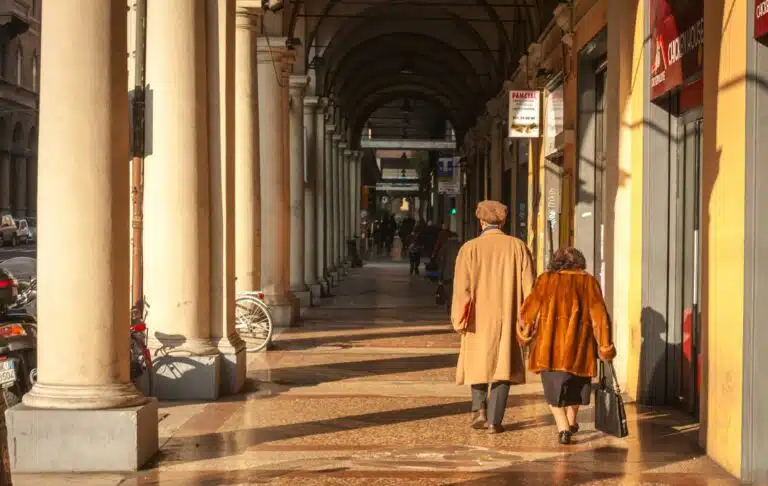
Bologna has 62km of porticoes citywide, with 42km inside the historic center, so long stretches offer shelter from rain and sun. This is genuinely one of the city’s best practical features.
For reference: Piazza Maggiore to the Due Torri is a 5-minute walk. Piazza Maggiore to the Quadrilatero market is 3 minutes. Most of the 2-day Bologna itinerary is entirely walkable from a central hotel.
Taking the Bus (TPER)
For neighborhoods slightly outside the center, or if your legs need a break, Bologna’s TPER bus network is reliable and easy to use.
Paying: Tap any contactless card or phone at the green validator on board. A standard urban ticket costs €2.30 and is valid for 75 minutes.
Planning: Schedules and diversions change, so check the current TPER timetable rather than relying only on a fixed set of tourist bus numbers.
Key route from the station to the center:
- Lines 25 and 30: both stop at Bologna Centrale, Ugo Bassi and Rizzoli, the quickest bus link from the station toward the center (checked against the TPER 2026/27 winter timetables)
Note: TPER’s 2026/27 winter timetable starts on 15 September 2026. If you are traveling around the timetable change, check your route again before departure.
Taxis in the City
For getting back from a late dinner, reaching Bolognina from the center, or traveling with children or heavy bags, taxis are practical.
Use the itTaxi or FREE NOW apps to book, or go to an official rank. Do not try to hail a taxi on the street. Official ranks exist at Piazza Maggiore, Bologna Centrale, and a few other key points.
Renting a Bike
Bologna’s current public bike-sharing service is MoBike, operated by RideMovi, with docking stations across the urban area. The city has no shared e-scooter service; scooter sharing has been ruled out because of the porticoes.
Bike sharing is most useful for reaching Bolognina, the Parco della Montagnola, or areas slightly outside the ZTL. Inside the historic center, walking remains the simpler option.
Part 4: The ZTL: What Every Driver Must Know
This section can save you an expensive surprise several weeks after your trip.
Bologna operates a ZTL (Zona a Traffico Limitato), a restricted traffic zone covering the entire historic center. Cameras monitor every entry point, and standard restrictions run every day from 7:00 AM to 8:00 PM.
After 8:00 PM is not automatically unrestricted, and this is the part most guides leave out. The zona T, via Rizzoli and via Ugo Bassi, the main axis between Piazza Maggiore and the Two Towers, is monitored 24 hours a day and becomes fully pedestrian on Saturdays, Sundays and public holidays. The pedestrian areas and the Archiginnasio area have their own 24-hour restrictions too. Driving through at 9 PM because the standard ZTL is “off” is exactly how people get fined.
If you drive through a ZTL camera without an authorized permit, you receive a fine automatically, sent to your home address, often weeks later. Rental car companies typically add an administrative fee on top of the actual fine.
How to avoid it:
- Do not drive into the historic center at all unless your accommodation has arranged access
- If your hotel or B&B is inside the ZTL, contact it before arrival. Eligible accommodation providers can submit guest license plates for authorized access
- Park at a large garage outside the center (Parcheggio Piazza VIII Agosto is well-located) and walk in
- For the historic center, walking, taxi, or bus is always the safer option
- If you genuinely need to drive in once, the city sells a digital day ticket for €6, or €15 for four consecutive days. Activate it before you enter and wait for the confirmation message. These tickets do not cover the 24-hour zones above, do not include free parking, and a non-Italian plate needs the correct format entered or it will be rejected
See our Where to Stay guide for hotels that handle ZTL registration for guests
Part 5: 2026 Tram Update
The major central tram construction on Via Riva di Reno, Via Indipendenza, and Via San Felice has finished. Via Riva di Reno reopened in November 2025, Via Indipendenza reopened in December 2025, and Via San Felice reopened to cars and public transport on 23 March 2026. The central section of Via Indipendenza is now permanently pedestrian, apart from the future tram service.
Work on the Linea Rossa (Red Line) has not finished everywhere in Bologna. Official city notices still list tram-related restrictions on Via San Donato and on several outer routes, including Viale Aldo Moro, Viale della Fiera, and Viale Europa. These locations are outside the main sightseeing core, but the works can affect buses and road traffic there.
What this means practically:
- The central streets are open again, with no diversions on Via Indipendenza, Via Riva di Reno or Via San Felice
- The central stretch of Via Indipendenza is quieter than it was during the works, since it is now pedestrian only
- Bus routes through the center have returned to their normal paths, though outer routes near the remaining worksites can still see changes
- The Marconi Express and Bologna Centrale are not affected by the remaining works
The honest takeaway: if you read an older guide warning you to avoid Via Indipendenza or Via Riva di Reno, that advice is out of date. The Linea Rossa is expected to enter service in 2027, but no official opening date has been published, and final works continue on some routes outside the center.
Our Where to Stay guide covers the neighborhoods in detail. If you arrive by train or plane and skip the rental car, where to stay in Bologna without a car shows which bases make that easy.
Part 6: Using Bologna as a Rail Base for Day Trips
One of Bologna’s strongest practical advantages is its position on Italy’s high-speed rail network. From Bologna Centrale, you can reach an extraordinary range of destinations in under two hours.
Key Day Trip Train Times from Bologna
| Destination | Typical Fastest Time | Train Type | Approx. Cost | Book Via |
|---|---|---|---|---|
| Modena | About 20–30 min | Regional | From €4.50 | Trenitalia app |
| Parma | About 48–60 min | Regional / high-speed | From €8.50 | Trenitalia app |
| Ferrara | About 35–55 min | Regional | From €5.50 | Trenitalia app |
| Florence | About 37 min | Frecciarossa / Italo | Dynamic fares | Omio |
| Venice | About 1h 15–22 min | Frecciarossa / Italo | Dynamic fares | Omio |
| Milan | About 1 hour | Frecciarossa / Italo | Dynamic fares | Omio |
| Ravenna | Check the current timetable | Regional | From €8.50 | Trenitalia app |
| Verona | About 52–55 min | Frecciarossa / Italo | Dynamic fares | Omio |
Booking advice: regional train prices are fixed, so buy the same day if you like. High-speed prices rise closer to the date. For Florence, Venice, and Milan, book at least 1–2 weeks ahead for the best fares.
Frequently Asked Questions
How long does it take to get from Bologna Airport to the city center?
How much does it cost to get from Bologna Airport to the city?
Is it easy to get around Bologna without a car?
What is the ZTL and how do I avoid a fine?
Should I buy train tickets in advance in Bologna?
Is the Marconi Express running normally in 2026?
Plan Your Bologna Trip
With transport sorted, here is what to plan next:
- Where to Stay in Bologna: best neighborhoods and hotels by traveler type
- 2 Days in Bologna: the best-tested itinerary for a first visit
- Best Day Trips from Bologna by Train: Florence, Modena, Venice and more
- Best Cooking Classes in Bologna: book before you arrive
- Bologna Trip Cost 2026: full budget breakdown including transport
- Is Bologna Safe? Neighborhood guide and 2026 safety overview
- Bologna with Kids: family transport tips and logistics
- Start Here: plan the trip around your arrival, by how many days you have
The practical side of a Bologna trip, timing, budget, getting around and how long to stay, is collected in Plan Your Trip.