Is Bologna Safe? Tourist Safety Guide & Areas to Avoid (2026)
Yes. Bologna is generally safe for tourists who use normal city precautions, but it is not accurate to describe it as a low-crime city.
The main practical risks are theft in crowded places and a less comfortable atmosphere around Bologna Centrale and Montagnola late at night. Official 2024 police data placed the Bologna metropolitan area fourth in Italy for reported crimes per resident in the 2025 Il Sole 24 Ore crime index. That figure covers the wider metropolitan area and is affected by commuters, students, and visitors, so it is not a direct measure of tourist risk.
For travelers, the useful question is more specific: where should you pay extra attention, and when? This guide answers that with current information on the station area, Montagnola, nightlife, pickpocketing, solo travel, tram works, and emergency numbers.
Planning your first visit? Our complete first-timer guide to Bologna covers safety alongside 14 other things to know before you arrive.
Want the practical checks before you go?
Bologna Trip Checklist: 12 things to check before you go
First: The Graffiti Factor
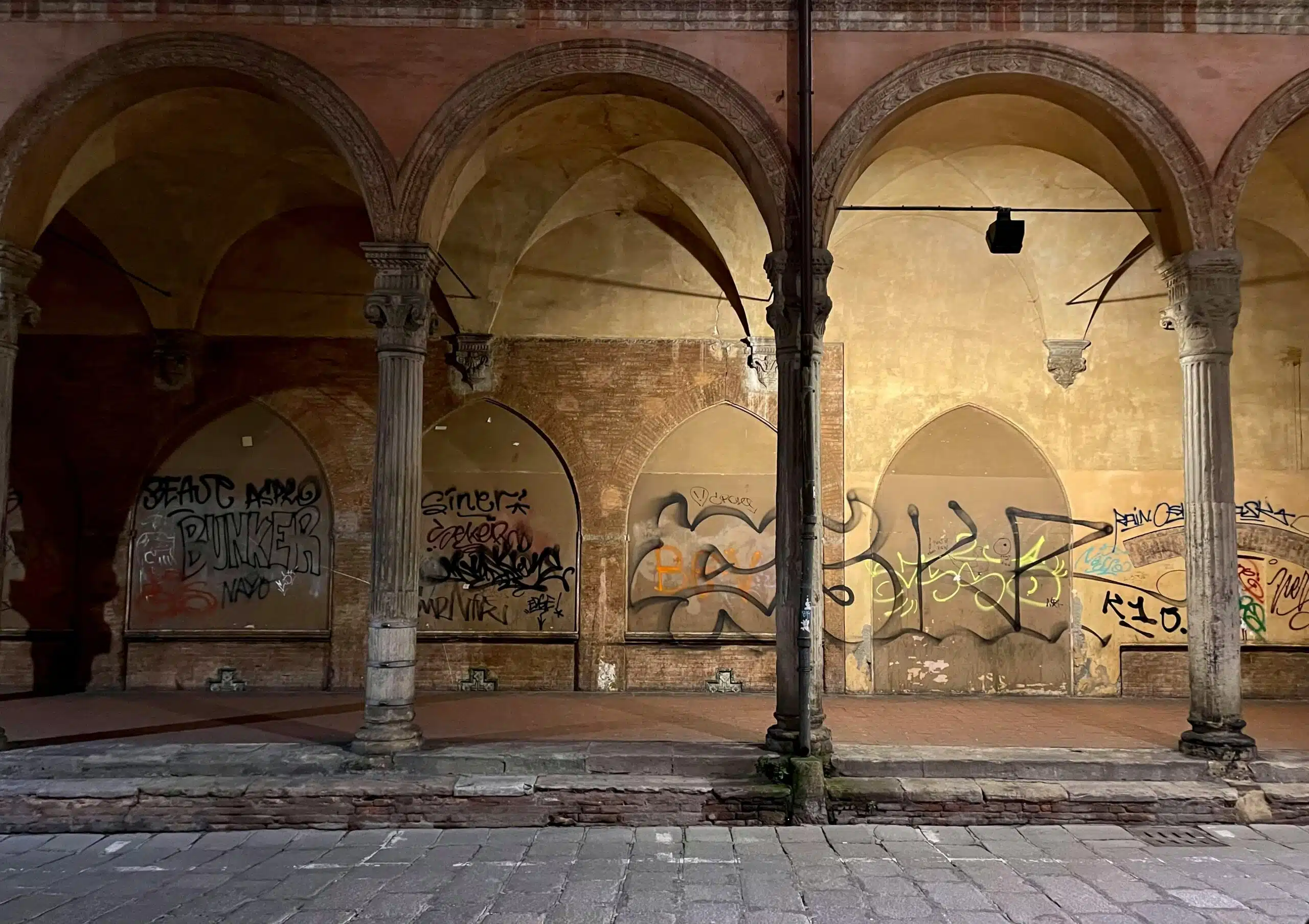
Graffiti is common across Bologna’s historic center, especially around the University District. It is not a useful shortcut for judging whether a street is safe.
A heavily tagged portico can still be busy with students, residents, and bars. A cleaner side street can be much quieter. Pay attention instead to lighting, foot traffic, your route, and what is happening around you.
Areas to Be Aware Of
Most visitors do not need a list of neighborhoods to avoid. A few specific places deserve more attention after dark.
1. Bologna Centrale Station Area Late at Night
Bologna Centrale is a major transport hub, so crowds and heavy foot traffic are normal during the day. Keep the same watch on your phone, wallet, and luggage that you would at any large Italian station.
Late at night, use more care immediately outside the station around Piazza Medaglie d’Oro, Piazza XX Settembre, and the streets beside Montagnola. These areas continue to receive targeted police controls.
Practical advice:
- Keep valuables zipped away when moving through the station and forecourt
- If you arrive late by train with luggage and do not know your route, a taxi to your accommodation can be the simpler option
- If you walk toward the historic center, Via dell’Indipendenza is the most direct main route
- If you arrive late at Bologna Airport and prefer door-to-door transport, a pre-booked airport transfer is another option
2. Montagnola Park After Dark
Montagnola sits next to the station area and hosts part of La Piazzola market every Friday and Saturday. During market hours and daytime, it is a busy public space.
After dark, it is reasonable to skip the park as a shortcut, particularly if you are alone or unfamiliar with the area. Police operations continue to focus on Montagnola and the surrounding station zone in connection with drug dealing and street crime.
If you are walking from Bologna Centrale into the center at night, stay on Via dell’Indipendenza rather than cutting through the park.
3. Via del Pratello Late at Night
Via del Pratello is a major nightlife street with bars, restaurants, and people drinking outdoors. The issue is not that it becomes a no-go area. It becomes noisier, more crowded, and more alcohol-focused as the night continues.
Keep your belongings close in busy bars and on the street. If you want a quieter walk home, choose a main lit route rather than lingering around the busiest late-night groups.
Bologna Safety at a Glance
| Area | What to Expect | Practical Approach After Dark |
|---|---|---|
| Historic center | Busy around the main squares and shopping streets | Use normal city precautions and watch belongings in crowds |
| University District | Active late, especially around Via Zamboni and Piazza Verdi | Stay on busy, lit routes and expect noise around nightlife spots |
| Via del Pratello | Bar and restaurant traffic, especially later in the evening | Keep valuables secure and leave if the atmosphere becomes uncomfortable |
| Bologna Centrale and Piazza Medaglie d’Oro | Major transport zone with continued police attention | Keep luggage close and consider a taxi for an unfamiliar late-night arrival |
| Montagnola Park | Busy by day and during La Piazzola market | Do not use the park as a late-night shortcut |
| Bolognina | Residential and commercial area north of the station | Know your route if your accommodation is here and use transport if you prefer not to walk late |
If your priority is a central base that keeps most sightseeing on foot, Centro Storico, Santo Stefano, and the Jewish Quarter are practical areas to compare. That is a location choice, not a verified crime ranking. Compare hotels in those three neighborhoods on Expedia.
Pickpockets and Theft
Petty theft deserves more attention than a long list of Bologna-specific scams. Current travel guidance for Italy warns about pickpocketing and bag-snatching in city centers, crowded tourist areas, public transport, and major stations.
Where to be more careful:
Bologna Centrale and busy transport stops: Keep your luggage in contact with you and avoid putting a phone or wallet in an easy-access outer pocket.
Crowded buses: Wear a backpack in front when the bus is packed. Keep a hand on zipped bags when people are getting on or off.
Piazza Maggiore, markets, and other crowded sights: Crowds and distractions create opportunities for theft. Put your phone away when you are not using it.
Bars and cafe tables: Do not leave a phone or wallet unattended on the table or on the back of a chair.
Distraction is the common pattern to plan for. If a stranger presses close, tries to rush you, or offers unsolicited help while you are handling money, tickets, or luggage, secure your belongings before engaging.
Is Bologna Safe for Solo Female Travelers?
Yes, many solo female travelers visit Bologna without problems, but the practical advice is the same as for other solo city trips: stay aware of your route, belongings, surroundings, and transport options after dark.
The historic center has plenty of evening activity, especially around restaurants, bars, and the University District. That does not make every street equally comfortable at every hour. Around Bologna Centrale and Montagnola, use the extra caution described above.
What to know:
- Choose busy, well-lit routes when walking alone late at night
- Keep drinks with you and do not accept an unattended drink from a stranger
- If a route from the station feels uncomfortable, take a taxi rather than forcing the walk
- Share your accommodation details and late-night plans with someone you trust if that helps you travel more comfortably
For a social first evening: A small-group food tour gives you a structured evening in the center and introduces you to several areas without planning every stop yourself.
For evening drinks: Bologna’s aperitivo scene is easy to combine with a central evening walk. See The Ultimate Bologna Aperitivo Guide: best bars and local rules for how it works and where to go.
2026 Tram Update: Major Central Works Are Mostly Finished
The major Linea Rossa works on Via dell’Indipendenza, Via Riva di Reno, and Via San Felice are finished, but Bologna’s tram project is not completely done.
Via Riva di Reno returned to traffic in late November 2025. Via dell’Indipendenza reopened on December 23, 2025, and Via San Felice reopened to cars and buses on March 23, 2026.
The central section of Via dell’Indipendenza between Via Rizzoli/Ugo Bassi and Via Righi/de’ Falegnami is reserved mainly for pedestrians and cyclists before tram service begins. Cross traffic remains possible at specified intersections.
The city is dismantling completed work sites and preparing the first 7 kilometers of the Linea Rossa for testing. Finishing work, cable installation, testing preparations, and Linea Verde construction continue in parts of Bologna.
What this means for visitors:
- The major construction phase on the central streets named above is over
- Temporary works can still affect individual routes, so do not assume the entire tram project has finished
- Via dell’Indipendenza remains the direct walking route between the station area and the center
- Bologna is preparing for tram operations from 2027, but no exact public opening date should be treated as fixed yet
For area-by-area accommodation notes, read Where to Stay in Bologna: neighborhood by neighborhood.
Emergency Information
For an emergency in Bologna, call 112. The number connects you to police, fire, or medical emergency services and is free to call. In Emilia-Romagna, the single 112 emergency system has been active across the region since April 1, 2025.
You can also use the established service-specific numbers:
- State Police: 113
- Medical emergency: 118
- Fire brigade: 115
When in doubt, call 112.
Pharmacies
Bologna pharmacies must provide at least the municipal minimum weekday hours of 8:30 AM–12:30 PM and 3:30 PM–7:30 PM, although many stay open longer.
Night, Sunday, and holiday coverage operates through a duty system. AUSL Bologna publishes the current list of duty pharmacies, and closed pharmacies commonly display information about nearby duty coverage.
Staying Safe: Practical Summary
Bologna does not require unusual precautions for most visitors. The useful habits are simple.
Do:
- Keep bags closed and valuables hard to reach in crowds
- Use main, lit routes after dark
- Take a taxi from the station if you arrive late with luggage and do not know the route
- Keep your phone off cafe tables when you are not using it
- Call 112 in an emergency
Do not:
- Use Montagnola Park as a shortcut late at night
- Treat graffiti as a safety map
- Assume every crowded bus or tourist square is theft-free
- Let an unfamiliar late-night route become a test of confidence
For central areas and specific hotel suggestions, see Where to Stay in Bologna: neighborhood safety and hotel guide.
Frequently Asked Questions
Is Bologna Safe for Tourists?
Yes. Bologna is generally safe for tourists using normal city precautions, but it should not be described as a low-crime city. The main visitor concerns are theft in crowded places and extra caution around Bologna Centrale and Montagnola late at night.
What Areas Should I Avoid in Bologna?
There is no evidence-based reason to label whole central neighborhoods as no-go areas for tourists. After dark, avoid using Montagnola Park as a shortcut and pay extra attention around the immediate station forecourt. Via del Pratello is a nightlife street, so expect more noise, crowds, and alcohol late at night.
Is Bologna Safe for Solo Female Travelers?
Yes, Bologna can work well for solo female travelers with normal urban precautions. Use busy, lit routes at night, keep control of your drinks and belongings, and consider a taxi if you arrive late at the station and your route feels uncomfortable.
Is the Graffiti in Bologna a Sign of Danger?
No. Graffiti is common in the historic center and University District, but it is not a reliable measure of street safety. Judge a route by lighting, activity, foot traffic, and what is happening around you.
Is the Tram Construction in 2026 a Safety Issue?
The biggest central Linea Rossa work sites on Via dell’Indipendenza, Via Riva di Reno, and Via San Felice are finished. However, testing preparations, finishing work, and Linea Verde construction continue elsewhere, so temporary route changes are still possible.
Is Bologna Safe for Families With Children?
Yes, most families can use the same normal city precautions described in this guide. Watch bags and phones in crowded places, supervise children around traffic and tram infrastructure, and plan late arrivals before you travel. For family-specific logistics and activities, see Visiting Bologna with Kids: the complete family guide.
Plan Your Trip
With safety covered, these guides help with the rest of the practical planning:
- Where to Stay in Bologna: safest neighborhoods and best hotels
- Bologna Transport Guide: airport, trains, buses, and ZTL
- 2 Days in Bologna: the best-tested itinerary for a first visit
- Best Cooking Classes in Bologna: one of the safest, best-value experiences in the city
- Best Day Trips from Bologna by Train
- Bologna Trip Cost 2026: full budget breakdown
- Start Here: pick your trip length and we point you at the guides that decide the rest
The practical side of a Bologna trip, including timing, budget, transport, and trip length, is collected in Plan Your Trip.