Best Day Trips from Bologna by Train: Florence, Venice, San Marino & Food Valley (2026)
Bologna is one of the most practical bases for train day trips in Italy. Florence takes 37 minutes by high-speed train, Verona starts at 52 minutes, Venice at 1 hour 19 minutes, and Modena is about half an hour away on a regional train.
The easiest trips are Modena and Ferrara, the strongest big-city trip is Florence, and the best cultural alternative is Ravenna. San Marino and Dozza also work, but neither is a train-only journey, and we say so in each section.
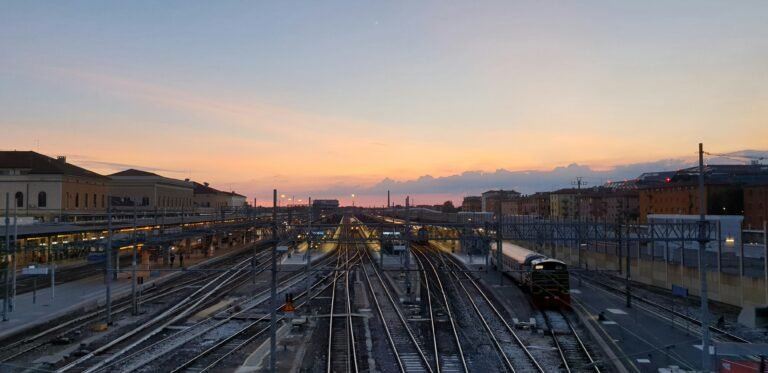
That is the case for staying in one hotel and returning every evening: no repacking, no second hotel bill, and dinner back in Bologna. See the best places to stay in Bologna by traveler type and budget. If every trip starts at the station, where to stay in Bologna without a car compares 11 hotels by walking time to Bologna Centrale.
Here are the 9 best day trips from Bologna by train in 2026, in order of travel time.
Quick Comparison: All 9 Day Trips at a Glance
| Destination | Typical time | Best for | Planning point |
|---|---|---|---|
| Modena | About 25 to 30 min | Food, Ferrari history, balsamic | Easy regional train |
| Ferrara | About 35 min | Cycling, castle, city walls | Easy regional train |
| Florence | 37 min | Renaissance art | High-speed train and timed museum entry |
| Parma | About 50 to 57 min | Prosciutto, Parmigiano, opera | Regional train; producers need a tour |
| Verona | From 52 min | Roman history, walkable center | High-speed train; Juliet’s House needs a booking |
| Ravenna | About 1 hr 10 min | Mosaics, UNESCO monuments | Check the timetable for your date |
| Venice | From 1 hr 19 min | Grand Canal, St. Mark’s | Book to Venezia Santa Lucia |
| San Marino | About 2.5 hr (train and bus) | Mount Titano, three towers | Bus timetable sets the day |
| Dozza | Variable, 1.5 hr or more | Murals, fortress, regional wine | Not train-only; taxi or local bus |
These are planning times, not guaranteed schedules, so check Trenitalia or Italo for your travel date.
1. Modena: Best for Food, Ferrari History, and Balsamic
Train time: about 25 to 30 minutes
Train type: regional, about €4.50 one way
Station to center: about 15 minutes on foot
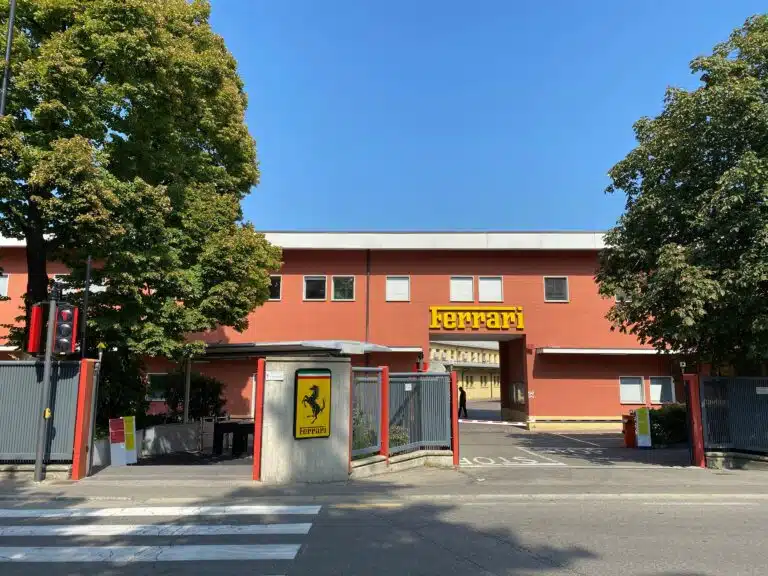
Modena is the easiest all-round day trip on this list. Its compact center combines food, automotive history and UNESCO-listed monuments, and Osteria Francescana, Massimo Bottura’s restaurant, is here.
One distinction about the cars: Ferrari has deep roots in Modena and nearby Maranello, and Maserati’s historic home is Modena. Lamborghini is based in Sant’Agata Bolognese, outside Modena. See our Bologna and Motor Valley Museums guide for the wider region.
Morning: start at the Enzo Ferrari Museum, a short walk from the station. The building is designed to echo a car bonnet, and the exhibitions rotate between road cars and Formula 1 history.
Lunch: the Mercato Albinelli is a good stop for local products and lunch. Franceschetta58 is Bottura’s more accessible bistro, so book ahead.
Afternoon: walk to Piazza Grande and the Cathedral, both UNESCO-listed. To climb the Ghirlandina Tower, reserve a time slot first: admission is by advance booking only, with a maximum of 25 visitors per slot, and the visit stops at the Sala dei Torresani rather than the very top (VisitModena). There are about 200 steps and no lift.
Before you leave: look for Aceto Balsamico Tradizionale di Modena DOP in the standard 100 ml bottle. Prices vary a lot by producer and age, so compare the labels instead of expecting a fixed price.
If you would rather learn than shop, stay in Bologna and take a pasta-making class with a local host.
For both Ferrari museums, balsamic producers and three ready-made itineraries: Read our Bologna to Modena Day Trip guide.
2. Ferrara: Best for Cycling and Castello Estense
Train time: about 35 minutes
Train type: regional, about €5.50 one way
Station to center: about 25 minutes on foot to the castle, or by bike
Ferrara is a compact Renaissance city with wide, flat streets, and cycling is the point of going. A bike is the best way to cover it, and rental operators change, so check current options before you rely on the station. Our Ferrara day trip guide covers the castle prices, the walking times and the MyFE Card.
The castle: Castello Estense sits in the middle of the city, a moated fortress with decorated rooms and historic prisons. Allow an hour to an hour and a half, and check the opening hours for your date.
The walls: about 9 km of walls circle the historic center, and you can walk or cycle along them. It is the clearest reason to choose Ferrara over another art city.
The food: order cappellacci di zucca, pasta filled with pumpkin, a Ferrara specialty.
3. Florence: Best for Renaissance Art
Train time: 37 minutes by Italo or Frecciarossa high-speed train
Station: Firenze Santa Maria Novella
Regional alternative: far slower, so take the high-speed train
Florence in 37 minutes is the strongest argument for basing yourself in Bologna. The high-speed journey makes a full museum day realistic.
Before you go:
- Book the Uffizi in advance. The museum sells timed tickets online through its official ticket office, and advance booking is sensible on busy dates (Uffizi Galleries).
- Book the train early. High-speed fares rise as the date gets closer.
- Go to Firenze Santa Maria Novella, not Rifredi or Campo di Marte.
Morning: Piazza del Duomo, with the cathedral facade and Giotto’s Bell Tower. If you plan to climb the dome, check the current pass and time-slot rules before you arrive.
Midday: the Uffizi Gallery. Botticelli, Leonardo and Raphael are all here, so allow at least an hour and a half.
Lunch: All’Antico Vinaio on Via dei Neri is the famous schiacciata sandwich stop. It is busy at peak lunch time, so expect a line.
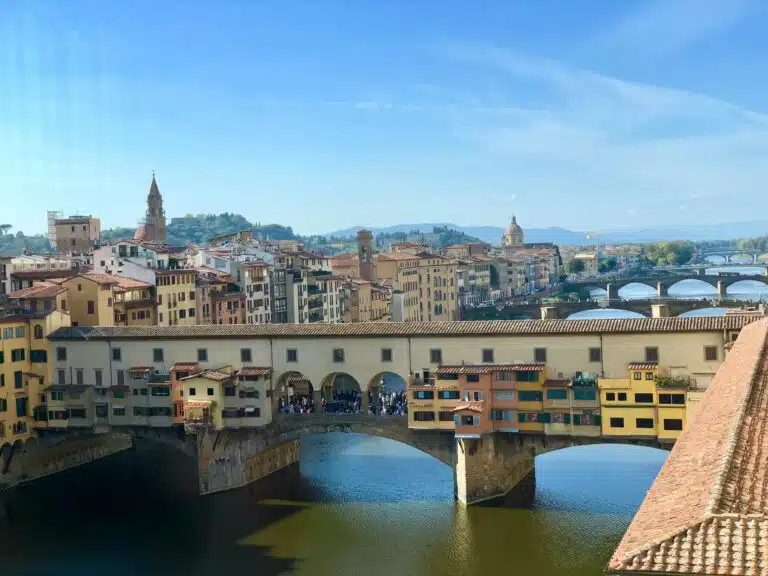
Afternoon: cross the Ponte Vecchio and continue uphill to Piazzale Michelangelo for the panorama. The walk takes roughly 20 minutes for many visitors.
For the full plan, including train strategy and the Uffizi versus Accademia decision: Read our dedicated Bologna to Florence Day Trip guide.
4. Parma: Best for Prosciutto, Parmigiano, and Opera
Train time: about 50 to 57 minutes
Train type: regional, about €8.50 one way
Station to center: about 15 minutes on foot
Parma works best when food is the priority but you still want a proper city center. Prosciutto di Parma and Parmigiano Reggiano both come from here and the surrounding hills, and the cathedral, baptistery and opera house give the day more range.
Morning: visit the Cathedral and the pink marble Baptistery. The Cathedral is free for individual visitors, the Baptistery and Diocesan Museum use a separate visitor pass, and visits pause during religious services (Piazza Duomo Parma).
Lunch: order a tagliere, a board of Prosciutto di Parma, often with torta fritta, at a trattoria in the center.
Producers: cheese dairies and ham producers sit outside the center, so a visit needs transport and usually an appointment. By train, a guided tour is the simplest way to add the countryside.
Opera: check the Teatro Regio for performances on your date.
For producer visits and ready-made itineraries: Read our full Bologna to Parma Day Trip guide.
5. Verona: Best for Roman History and a Walkable Center
Train time: from 52 minutes on the direct Italo high-speed train (Italo)
Station: Verona Porta Nuova
Station to center: about 20 minutes on foot, or a local bus
Verona is often written off as a Shakespeare stop, but the Roman arena, Piazza delle Erbe and the river bend fit comfortably into one day.
The Arena: the Arena di Verona is a 1st-century Roman amphitheater that still stages opera in summer. Check the opening hours for your date, because performances and events can change daytime access.
Juliet’s House: this needs planning now. Since April 1, 2026, entry to the courtyard and the house is only through the Teatro Nuovo in Piazzetta Navona, tickets are sold online only, and an online reservation is mandatory (Visit Verona). If it is not important to you, the balcony is not worth building the day around.
The walk: Piazza delle Erbe, Piazza dei Signori and the Adige riverfront sit close enough to combine on foot.
Wine: Verona is the gateway to Valpolicella. A glass of Amarone or Ripasso at an enoteca is easy, but a winery visit is a separate excursion.
6. Ravenna: Best for Mosaics
Train time: about 1 hour 10 minutes on direct regional services
Station to center: about 10 minutes on foot
Planning note: check the live timetable for your date, since works can change journey times
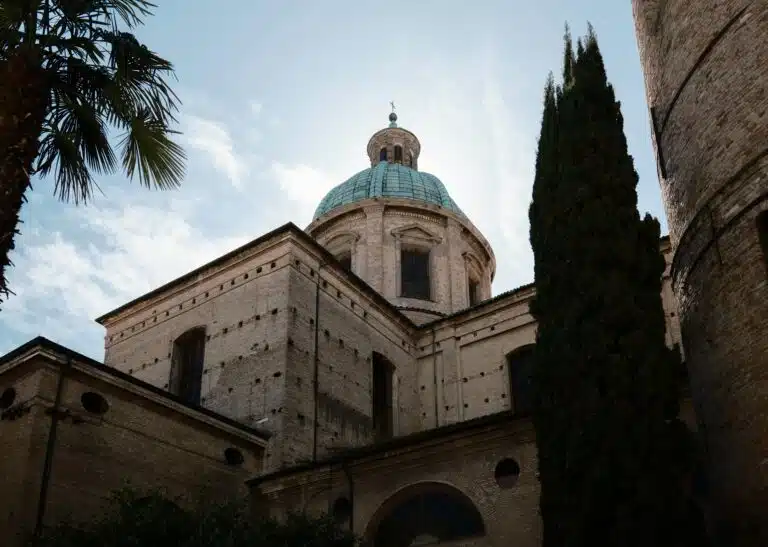
Ravenna was a capital of the late Roman Empire and later a center of Byzantine power in Italy. The brick churches look plain from outside, and inside they hold remarkably intact 5th and 6th century mosaics, several of them UNESCO-listed.
Start with the Basilica of San Vitale and the Mausoleum of Galla Placidia, whose small blue-and-gold ceiling is the highlight. Monument tickets come in different combinations, so check the official Ravenna tourism site for the one that fits your route before you buy.
Ravenna is also the nearest big city to Mirabilandia, which describes itself as Italy’s largest amusement park. It is a separate family day, not an add-on to a mosaics day. See our Bologna with Kids guide for family day trip options.
For ticket combinations, Galla Placidia, Dante’s Tomb and a full itinerary: Read our full Bologna to Ravenna Day Trip guide.
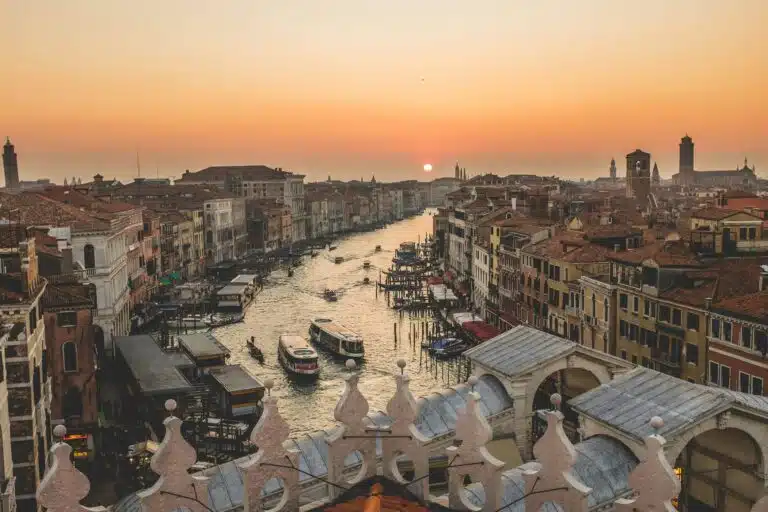
7. Venice: Best for a Full-Day Headline Trip
Train time: from 1 hour 19 minutes on the direct Italo high-speed train (Italo)
Station: Venezia Santa Lucia, not Mestre
Venice works as a day trip from Bologna, but it is a long, tiring day. The arrival is the best part: Venezia Santa Lucia opens directly onto the Grand Canal, so there is no transfer into the historic center.
Station warning: the line also stops at Venezia Mestre, on the mainland. Book to and from Santa Lucia.
Morning: walk from the station toward the Rialto Bridge through Cannaregio and San Polo. Allow about 30 minutes or more, depending on stops.
Lunch: try cicchetti, small bites served at traditional bacari. Order a few pieces rather than a set menu, since the cost depends on the bar and the drinks.
Afternoon: St. Mark’s Basilica and the Doge’s Palace. The Basilica has an official online ticket office, and the Doge’s Palace publishes seasonal hours, so check both for your date (St. Mark’s Basilica).
Access fee: the 2026 Venice access fee period ran from April 3 to July 26, and the municipality has said the trial ended with no payment or exemption request needed from July 27. Rules for 2027 depend on a new decision, so check the city’s access fee site before you travel.
Going home: pick your return train before you leave Bologna and leave enough margin to walk back to Santa Lucia. The trip back is more than an hour, so do not plan a dinner time you cannot make.
Avoid: summer weekend middays, when heat and crowds peak in the narrow streets.
For train prices, the access fee and a full one-day route: Read our full Bologna to Venice Day Trip guide.
8. San Marino: Best for Mount Titano and a Second Country
Travel time: about 2.5 hours each way (a regional train to Rimini of 75 to 95 minutes, plus a 55-minute bus)
Cost: about €18 each way (regional train about €11.30, bus €7)
San Marino is possible as a day trip, but it is the longest and most connection-dependent option here, and it is not a train-only journey. UNESCO describes it as one of the oldest republics in the world and the only surviving Italian city-state (UNESCO).
- Train from Bologna Centrale to Rimini.
- Bonelli and Benedettini shuttle from Rimini station to San Marino. It runs eight times a day in each direction on the timetable valid from September 15 to November 7, 2026, with the last bus back at 19:00, and your ticket is valid only for the booked ride (Bonelli Bus).
- Choose your bus first, then fit the Bologna trains around it. A different winter timetable applies from November 8.
Walk the three medieval towers along the ridge of Mount Titano and spend time around Piazza della Libertà. The views on a clear day reach toward the Adriatic.
The Tourist Information Office at Piazza Garibaldi 5 offers a tourist visa for your passport at €5, a souvenir rather than a border stamp (Visit San Marino). Do not assume shopping is cheaper: the same rules on goods apply as for Italy.
For the bus timetable, the National Museums Pass and a realistic one-day plan: Read our full Bologna to San Marino Day Trip guide.
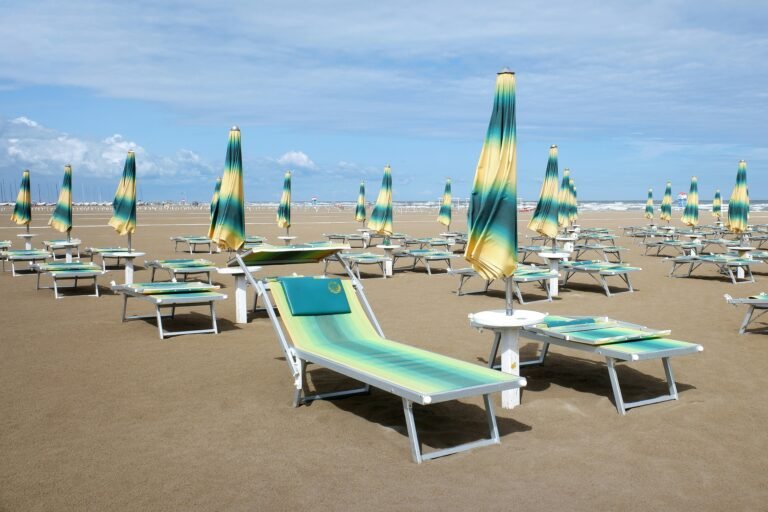
Making Rimini the destination instead? Read our full Bologna to Rimini Day Trip guide.
9. Dozza: Best for Murals and the Rocca Sforzesca
Travel time: variable, usually 1.5 hours or more without a car
Route: train to Imola, then a taxi or a local bus connection
Best for: a slower half day
Dozza is a hilltop village known for murals painted on its house walls, and for the Rocca Sforzesca fortress. It is the least straightforward trip on this list, and it is not a train-only journey.
Getting there: take the train to Imola, which is about 20 minutes from Bologna, then a taxi, which is the simplest option. By public transport, TPER’s line 101 connects to Toscanella, where the reservation-only Prontobus 147 runs to Dozza Imolese, and it must be booked at least 60 minutes before departure (TPER). We could not confirm that this reaches the hilltop village itself, so check the final stop with TPER or the town before you rely on it, and check the taxi fare directly.
The fortress: the Rocca Sforzesca houses the Enoteca Regionale dell’Emilia-Romagna, where you can taste wines from across the region. Opening days change, so check before you make it the anchor of your trip.
For Imola itself, the circuit tour and the Senna Memorial: Read our full Bologna to Imola Day Trip guide.
Essential Train Tips for Italy
High-speed trains (Frecciarossa and Italo): reserved seats, air conditioning and fast journeys. Fares work like airline fares, so book early. Compare trains with Omio in English, side by side for Trenitalia and Italo.
Regional trains (Regionale): fixed fares, slower, no reserved seats. They are the practical choice for Modena, Ferrara, Parma and Ravenna, and the timetable can change, so check it for your date.
Validation: a paper regional ticket must be validated at the platform machines before boarding, or you risk a fine. Trenitalia’s Digital Regionale Ticket is validated automatically at the scheduled departure of the train you selected, so it needs no check-in (Trenitalia).
Luggage storage: the Kipoint at Bologna Centrale is the official option, and apps like Bounce connect you to local shops and hotels that store bags.
Long days: for Venice and San Marino, choose the return connection before you leave Bologna.
For Bologna Centrale, the two station levels and buying tickets efficiently:
Bologna Transport Guide 2026: complete station and train guide
Frequently Asked Questions
What is the best day trip from Bologna by train?
For most first-time visitors, Florence is the strongest big-city trip: the high-speed train takes 37 minutes. Modena is the best choice for food and automotive history, Ferrara for cycling, and Ravenna for mosaics.
Which day trip from Bologna is the easiest?
Modena and Ferrara. Both have direct regional trains of about half an hour, compact centers, and no onward bus for the main sights.
Can you do multiple day trips in one Bologna stay?
Yes, and that is the point of using Bologna as a base. A four-night stay comfortably fits two or three day trips alongside two full days in the city. Treat each destination as its own day.
How far ahead should I book train tickets?
Book high-speed trains to Florence, Verona and Venice as early as your plans allow, because fares are dynamic. Regional fares are fixed, so they can be bought any time, but check the timetable for your date.
Do I need to book attractions in advance?
For several headline sights, yes. The Uffizi sells timed tickets online, the Ghirlandina in Modena is by reserved time slot only, and Juliet’s House in Verona requires an online reservation. St. Mark’s Basilica also has an official online ticket office.
Which day trips need more than a train?
San Marino needs a bus from Rimini, and Dozza needs a taxi or a local bus connection from Imola. Plan both around the onward transport rather than the train.
Can I do these day trips with children?
Yes, though some suit families better than others. Modena has the Ferrari museum, Ferrara suits cycling, and Ravenna can pair mosaics with a separate Mirabilandia day. Venice is manageable but tiring for young children. Bologna with Kids includes family day trip options.
Plan Your Bologna Base Camp
For everything you need before you go:
- Where to Stay in Bologna: best neighborhoods and hotels
- The 3 Best Day Trips from Bologna: Modena, Parma & Ferrari Valley, a more focused guide to the top three
- Bologna to Florence Day Trip: complete logistics guide
- Bologna Transport Guide: airport, station, and getting around
- Best Cooking Classes in Bologna: book one of your Bologna evenings for a pasta-making class
- Is Bologna Safe? 2026 safety guide
Every destination within easy reach of Bologna is collected in Day Trips.