Bologna vs Florence: Which City Is Better in 2026?
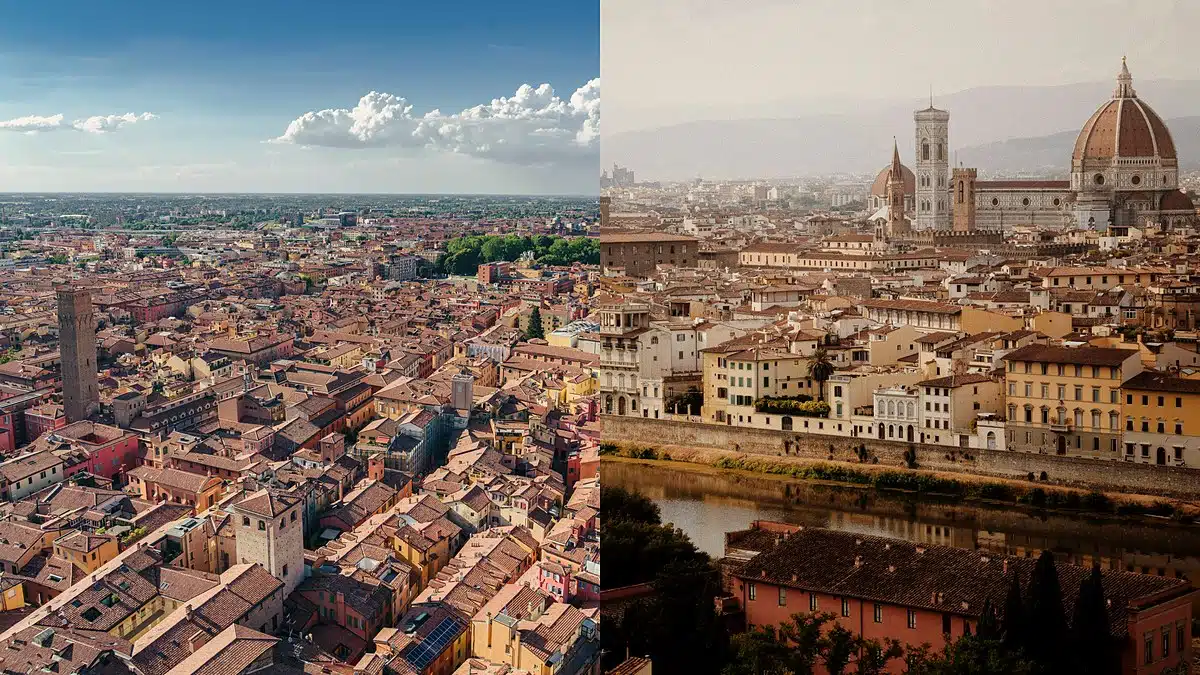
Choose Florence if Renaissance art is the main reason for your trip. Choose Bologna if food, lower tourism pressure, and rail access across northern and central Italy matter more.
You do not necessarily have to choose one city. The fastest Italo journey between Bologna Centrale and Firenze Santa Maria Novella takes 37 minutes, and advance fares start at €9.90 each way.
Our pick: Florence in a day tourBologna vs Florence at a Glance
| Category | Bologna | Florence | Better Fit |
|---|---|---|---|
| Renaissance art | Strong regional collections | Uffizi, Accademia, Duomo, Bargello | Florence |
| Food focus | Fresh pasta and Emilia-Romagna specialties | Tuscan cooking, including bistecca and ribollita | Bologna for Emilia-Romagna food |
| Visitor pressure | Lower overnight visitor volume | Much higher overnight and day-visitor volume | Bologna |
| Accommodation | Prices vary sharply by date | Prices vary sharply by date | Compare your exact dates |
| Day trips | Strong rail variety across several regions | Strong access to Tuscany | Depends on your priorities |
| Walkability | Compact historic center | Compact historic center | Tie |
| Bologna–Florence train | 37 minutes by fastest Italo service | 37 minutes by fastest Italo service | Tie |
Food: Bologna Has the Stronger Case
If food is one of the main reasons for your trip, Bologna is the stronger choice. Its advantage is specific: fresh pasta, mortadella, market culture, and direct access to the wider Emilia-Romagna food tradition.
The Quadrilatero is the historic market district behind Piazza Maggiore. Its medieval street pattern still holds food shops, market stalls, delis, and other small businesses.
Fresh pasta is central to the city’s food identity. Tagliatelle al ragù, tortellini in brodo, and tortelloni are easier to treat as part of an everyday Bologna itinerary than as one-off specialties.
Mortadella Bologna IGP is closely tied to Bologna’s gastronomic tradition. The Parmigiano Reggiano production area also extends into part of the Bologna area, while Aceto Balsamico di Modena is produced in Modena and Reggio Emilia provinces.
Florence has a distinct Tuscan food culture of its own, with bistecca alla Fiorentina and ribollita giving you two obvious reasons to eat seriously there. The difference is not that Florence lacks good food, but that Bologna makes food a more central part of the trip.
The Ultimate Bologna Food Guide: what to eat and where to go
Art and Museums: Florence Wins
Choose Florence if Renaissance art is your first priority. The Uffizi, Accademia, Duomo complex, Bargello, and Medici Chapels give Florence a concentration of major Renaissance collections that Bologna does not match.
The Uffizi costs €25 for a same-day full-price ticket or €29 when purchased before the visit date. The Accademia costs €20, with a €4 booking fee for a reserved time, and the museum strongly recommends reservations because waits can be long without one.
The Duomo complex uses separate passes, with the cathedral itself free to enter and the €30 Brunelleschi Pass covering the Dome, Bell Tower, Baptistery, museum, and Santa Reparata.
Bologna still has worthwhile museums beyond its better-known food culture. The Pinacoteca Nazionale costs €12 and focuses on painting connected to Bologna and Emilia. MAMbo costs €6 and includes access to the Museo Morandi, while Palazzo Poggi costs €10 and preserves scientific collections linked to the University of Bologna.
The Archiginnasio Anatomical Theatre offers something different from Florence’s major art museums: a 17th-century teaching space associated with the city’s university history.
Florence is the better art destination. Bologna is not trying to compete on the same terms.
Crowds: Bologna Has Lower Visitor Pressure
Florence handles substantially more visitor pressure than Bologna. In the first 10 months of 2025, Florence recorded 9.7 million overnight stays, and the city also estimated about 8 million day visitors across a 12-month period. Bologna recorded 4,876,947 overnight stays in all of 2025.
That difference changes how you should plan the two cities. In Florence, timed museum reservations matter more, especially for the Accademia, where the official museum warns that waits can be long without a booking.
Bologna’s lower visitor volume does not mean its center is empty. Piazza Maggiore, the Quadrilatero, and the university area can all be busy. The practical difference is that major visitor demand is less concentrated around a short list of globally famous sights.
Cost: Compare the Same Dates
Bologna can offer better value, but fixed citywide hotel ranges are not reliable enough for an evergreen comparison. Rates in both cities change by season, weekday, events, and how early you book.
Compare the same dates before choosing your base. A lower Bologna hotel rate can make the city attractive for a multi-day stay, but do not assume Bologna will be cheaper on every night of the year.
Museum pricing gives you a cleaner comparison than hotel rates. The Pinacoteca Nazionale in Bologna currently costs €12, MAMbo €6, and Palazzo Poggi €10. In Florence, the Uffizi is €25 on the day or €29 in advance, while the Accademia is €20 before any booking fee.
For a broader budget breakdown, see Bologna Trip Cost 2026: what a trip actually costs.
Day Trips: Bologna for Rail Variety, Florence for Tuscany
Bologna is the stronger base if you want to combine several regions by train, while Florence is the stronger base if Tuscany itself is the focus.
From Bologna, the fastest Italo services currently reach Florence in 37 minutes, Verona in 52 minutes, Milan in 1 hour 2 minutes, and Venice in 1 hour 19 minutes. Regional timetables also connect Bologna with destinations including Modena, Parma, Ravenna, and Rimini. Check your travel date because regional schedules can change.
Florence has a different advantage because Tuscany becomes the natural focus. Pisa, Siena, and other Tuscan destinations fit more naturally into a Florence-based itinerary, while Rome and Bologna are also connected by high-speed rail.
The right winner depends on the map you want to cover. Bologna gives you broader rail variety, while Florence puts Tuscany first.
Best Day Trips from Bologna by Train: routes and planning
Should You Stay in Bologna and Visit Florence for the Day?
Yes, if Bologna is your main base and you want one focused day in Florence. The 37-minute fastest Italo journey makes the day trip practical.
Do not try to treat Florence as a checklist. One major museum plus the historic center is a more realistic one-day plan than forcing the Uffizi, Accademia, Duomo monuments, and Boboli Gardens into the same day.
Book the museum you care about most before you build the rest of the schedule. The Accademia strongly recommends reservations, and the Uffizi charges different prices for same-day and advance tickets.
If you want a guide, a small-group tour in Florence covers Michelangelo’s David, the Uffizi and the Duomo area in one visit. You still travel from Bologna by train.
If Florence’s museums are the central purpose of your Italy trip, stay in Florence instead. A day trip is convenient, but it is not a substitute for several days of art.
Bologna to Florence Day Trip: a practical one-day guide
Who Should Choose Florence as Their Primary Base?
Choose Florence if the Uffizi, Michelangelo’s David, and Renaissance art are central to your trip.
Florence also makes more sense if most of your planned side trips are in Tuscany. Staying there reduces the need to cross Bologna simply to return south or west again.
It is also the better choice if you want several museum-heavy days. Florence rewards time, especially when you want to spread the Uffizi, Accademia, Duomo complex, Bargello, and Medici Chapels across separate visits.
Who Should Choose Bologna as Their Primary Base?
Choose Bologna if food culture is a major priority and you want a city that works well as a rail base.
It suits a trip that combines Bologna with places such as Modena, Parma, Ravenna, Venice, Verona, Milan, or Florence. That geographic range is the main advantage.
Bologna also makes sense if you want Florence to be one part of the trip rather than its organizing principle.
How Many Days in Bologna? Plan your stay around day trips
Accommodation: Where to Base Yourself in Bologna
If you choose Bologna, stay central enough that the station and historic center remain easy to reach. That matters more if you plan several early train trips.
Centro Storico works well for restaurants, markets, and major sights. A location closer to Bologna Centrale can be more convenient when day trips dominate your schedule.
Where to Stay in Bologna: neighborhood guide
Frequently Asked Questions
Is Bologna or Florence Better for Food?
Bologna is the stronger choice if you are traveling for fresh pasta and Emilia-Romagna food traditions. Florence has its own Tuscan specialties, but food plays a more central role in a Bologna-focused trip.
Is Bologna or Florence Better for Art?
Florence. The Uffizi, Accademia, Duomo complex, Bargello, and Medici Chapels make it the stronger choice for Renaissance art. Bologna has good museums, but this is not the category in which it should try to beat Florence.
Is Bologna Cheaper Than Florence?
Often, but not reliably on every date. Hotel prices change too much by season, weekday, and demand for a fixed evergreen range to be trustworthy. Compare the same dates in both cities before deciding.
Can You Do Florence as a Day Trip from Bologna?
Yes. The fastest Italo journey takes 37 minutes from Bologna Centrale to Firenze Santa Maria Novella, with fares starting at €9.90 each way. Book your main Florence museum before building the rest of the day.
Is Bologna More Authentic Than Florence?
“Authentic” is subjective, so it is not a useful citywide score. A more concrete difference is visitor pressure: Florence records far more overnight stays and also handles millions of day visitors, while Bologna has a larger share of everyday university and local city life in the center.
How Far Is Bologna From Florence?
The fastest Italo journey takes 37 minutes over 91 km. Italo lists 32 daily trains on the route, with advance fares starting at €9.90 each way.
The Verdict
Choose Florence for Renaissance art. Choose Bologna for Emilia-Romagna food culture and broader rail variety.
Choose Florence as your base if museums and Tuscany will fill most of your days. Choose Bologna if you want to combine food, Emilia-Romagna, and several rail day trips.
If both cities matter, the 37-minute fastest train means you can include both without changing hotels for a single day.
Plan Your Italian Trip
- How Many Days in Bologna? Plan your stay
- Best Time to Visit Bologna: month-by-month planning
- Where to Stay in Bologna: choose the right neighborhood
- Bologna to Florence Day Trip: step-by-step guide
- Best Day Trips from Bologna: train ideas from your base
- First Time in Bologna? 15 Things to Know
- The Ultimate Bologna Food Guide: what to eat
- Best Cooking Classes in Bologna: compare your options
Also deciding between Bologna and Rome? Our Bologna vs Rome comparison covers history, food, cost, and transport.
The practical side of a Bologna trip, including timing, budget, transport, and length of stay, is collected in Plan Your Trip.